Simplify Your Start
From Beginning To Your Personalized Needs
Investing in the UAE offers several compelling advantages. The UAE boasts a strategic location at the crossroads of Europe, Asia, and Africa, making it a key hub for international trade and commerce.
The country’s modern infrastructure, world-class facilities, and business-friendly environment further enhance its appeal to investors.
QUESTIONS/ANSWERS
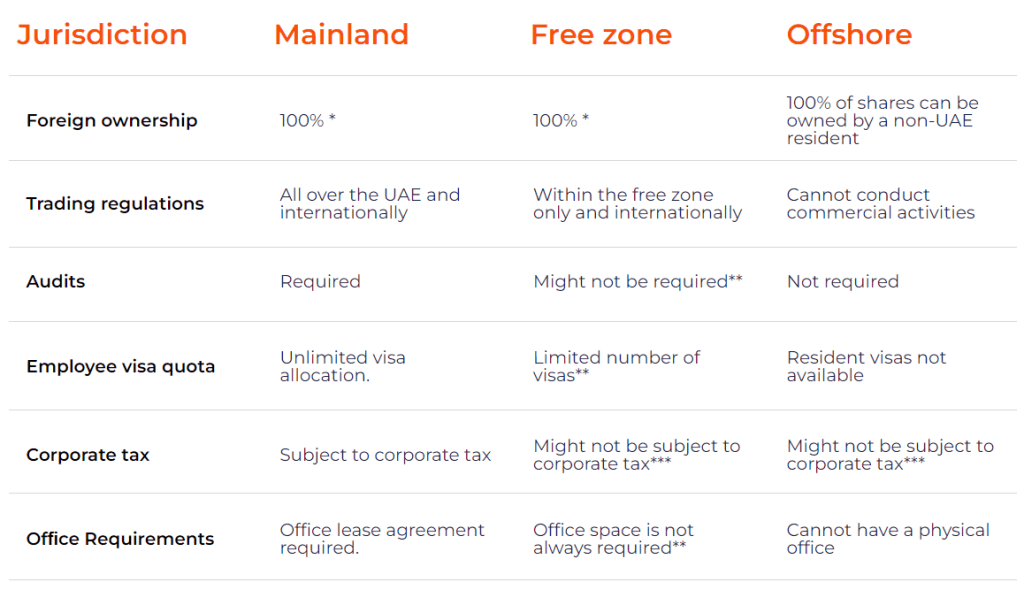
In free zones, all company types can be entirely owned by non-UAE nationals or expatriates. However, in the mainland, approximately 70-80% of business activities may allow non-UAE nationals or expatriates to have full ownership, while the remaining 20% still necessitate a local UAE national to hold 51% ownership, with the non-UAE national holding the remaining 49%.
Free zone enterprises enjoy the flexibility to conduct business activities and trade with other entities within their designated free zone boundaries and across global markets. This setup facilitates seamless transactions and collaborations with companies both locally and internationally. However, it’s important to note that despite this flexibility, free zone businesses are subject to certain restrictions when it comes to trading directly with customers located within Dubai and the wider mainland of the UAE. These restrictions aim to maintain the distinction between free zone jurisdictions and the mainland, preserving the integrity of each area’s regulatory framework while encouraging economic growth within both sectors.
Currently there is no personal income tax in the UAE. and no individual tax registration or reporting obligations. So, your personal income is tax free.
In accordance with Federal Law No. 32 of 2021, known as the Commercial Companies Federal Law, all companies operating in the UAE are mandated to undergo financial audits. Compliance with this requirement necessitates the maintenance of comprehensive financial records by these companies.
While companies based in free zones are generally exempt from mandatory audits and are not required to submit audit reports, certain entities within free zones, such as Free Zone Companies (FZCO) and Free Zone Establishments (FZE), may still be subject to compulsory auditing.
Even if not mandatory, free zone entities are often advised to prepare audit reports for internal purposes. Additionally, the audit report may be requested by immigration authorities at any point in the future, underscoring the importance of maintaining accurate financial records and conducting regular audits for businesses operating within free zones in the UAE.
Yes. With a tourist visa you can apply for a trade license and start your business. You can apply for your partner visa inside the UAE as soon as you get the trade license.
There are two common setups available to foreigners when starting a business in the UAE — the Free Zone and the Mainland. Mainland Businesses can be established anywhere and trade directly with the local market. Free zone businesses can trade from designated zones and require a local agent to trade directly in the UAE.
Start-ups have the opportunity to acquire a Trade License even without securing physical office space or Flexi desk arrangements. Within the Free Trade Zones, various company setup packages are available, ranging from options with no visa quota and Flexi-desk facilities to those offering up to 6 visa quotas along with fully furnished office spaces.
Certainly, irrespective of their legal structure or the nature of their operations, all companies incorporated in the UAE are required to undergo an audit as per regulatory guidelines.
The process of setting up a business in a Freezone can commence with an initial investment as minimal as AED 5,750, with the potential to scale up to AED 50,000 or more. This investment is contingent upon various factors such as the chosen Emirates, Free Zone location, and the specific business activity intended to be conducted.
In certain Free Zone arrangements, the initial investment may cover not only the necessary licensing fees but also the provision of office space and additional services tailored to the needs of the business. These additional services could include amenities like administrative support, utilities, and access to shared facilities. Consequently, the total cost of setting up a Free Zone business may vary depending on the package chosen and the level of services included.